Emergency air conditioning repair starts with safety
If you smell burning, see sparks or hear loud buzzing from the panel, switch the system off and leave it off.
Most AC failures are not dangerous, but electrical faults can be. When in doubt, turn the thermostat to Off and switch off the AC breakers, then call.
Five checks in five minutes
Work through these checks in order. Many emergency air conditioning problems in Cape Coral are solved by one of them.
Thermostat
Set it to Cool with the target a little under the room temperature. Replace the batteries if the screen is blank or dim.
Breakers
Find the AC and air handler breakers and reset a tripped one a single time. If it trips again, leave it off.
Outdoor disconnect
The switch or pull out block beside the outdoor unit should be on.
Drain pan and float switch
Water in the pan under the air handler may have shut the system off.
Filter
A clogged filter can freeze the coil and stop cooling. Replace it if it is gray.
If the system starts after one of these, watch it for an hour. If it stops again, the cause is still there.
More on the first two checks
The thermostat check catches more problems than people expect. A schedule may have switched the system to a higher setting, a child may have pressed a button, or the batteries may be just strong enough to light the screen but not to send the signal. Fresh batteries and a manual setting rule all of that out.
If the breaker for the outdoor unit has tripped, it may sit in a middle position rather than fully off. Push it firmly to off, then back to on. If it trips again at once, leave it there and call.
What your AC is doing and what it usually means
For emergency air conditioning repair in Cape Coral, the table below helps you describe the problem clearly.
| What you see | Likely cause | Next step |
|---|---|---|
| Nothing runs at all | Power, breaker, float switch or thermostat | Run the five checks |
| Indoor fan runs, outdoor unit silent | Contactor, capacitor or outdoor breaker | Leave it off and call |
| Outdoor unit hums, fan still | Failed capacitor | Switch cooling off now |
| Frost along the copper pipe | Weak airflow or a low charge | Cooling off, fan on to thaw |
| Water around the air handler | Clogged condensate drain | Switch off, protect the floor |
| Runs but blows warm air | Many possible causes | See the not cooling guide |
How to keep the house cool while you wait for repair
In a Cape Coral summer, a house heats up quickly once the AC stops. While you wait for emergency AC repair in Cape Coral, these steps help keep the house cooler.
- Close blinds and curtains on sunny windows.
- Run ceiling fans in occupied rooms, counterclockwise for a cooling breeze.
- Move to the coolest room, often an interior room or a lower floor.
- Avoid the oven and dryer, which add heat.
- Drink water and watch older people, young children and pets closely.
If anyone in the house is at risk from heat, treat the situation as urgent and consider going somewhere cool until the system is fixed.
After a storm or power outage
Summer and fall storms often bring power outages, and power that comes back in bursts is hard on the outdoor unit.
- Keep the thermostat on Off while power is unstable.
- Once power is steady, wait a few minutes before turning cooling on.
- Clear branches and debris from around the outdoor unit.
- If the unit sat in floodwater, do not run it until it has been checked.
The reset guide walks through restarting the system safely.
Safe and unsafe things to try when the AC quits
Worth doing
- Switching off at the thermostat first.
- Resetting a breaker once only.
- Letting a frozen coil thaw with the fan on.
- Protecting the floor from drips.
Worth avoiding
- Opening the outdoor unit panel.
- Resetting a breaker over and over.
- Chipping ice off the coil.
- Pushing the contactor in with a stick.
What to tell the technician
A clear description speeds up emergency air conditioning repair in Cape Coral more than anything else.
What it is doing
Say whether the system is silent, humming, blowing warm air, leaking or iced up.
When it started
Say whether it stopped after a storm, after a power cut or with no warning.
What you tried
Mention whether you changed the batteries or the filter, reset a breaker or checked the float switch.
The system type
Tell us whether it is an AC or a heat pump, and roughly how old it is.
A clear picture on the phone helps the technician arrive with the right parts. You will hear the options before any work starts.
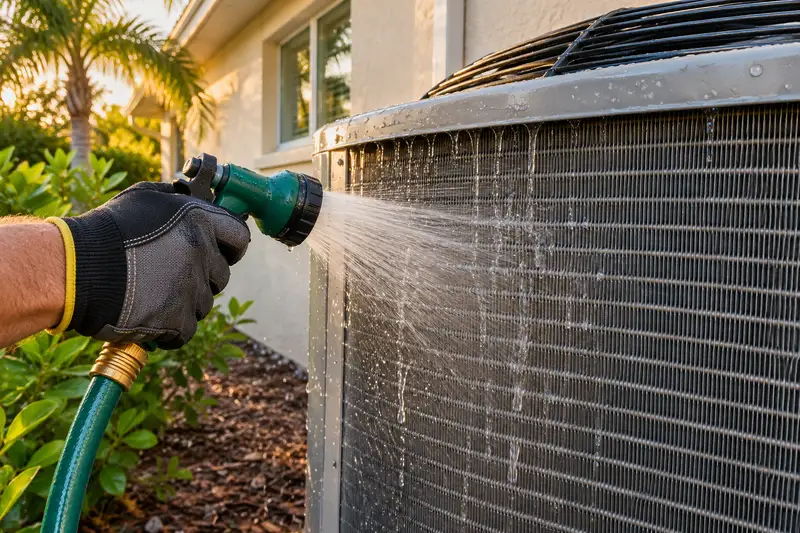
Preventing the next emergency
Most AC emergencies happen during the first heat waves of the year. A few habits make it far less likely that you will need emergency AC repair in Cape Coral at all.
- Book maintenance before the hottest stretch of the year.
- Change the filter monthly while the AC runs every day.
- Treat the condensate drain every few months.
- Keep the outdoor unit clear of plants and debris.
See AC maintenance visits for what a proper check covers.
Signs you should switch the AC off right away
Some symptoms are a reason to stop the system straight away and ask for emergency AC repair in Cape Coral rather than keep trying. Running a damaged system can turn a small repair into a large one.
A burning or electrical smell
Switch off at the thermostat and the breaker. Do not restart it until a technician has looked.
A loud hum with the outdoor fan still
The compressor is trying to start without help. A few minutes of this can overheat it.
Grinding or banging from the outdoor unit
A motor or loose part may be failing. Leave the system off.
Water reaching ceilings, floors or walls
Switch off and protect the area. Water damage spreads quickly.
A breaker that trips a second time
Something is drawing too much current. Repeated resets can damage wiring.
What to do when AC water drips through a ceiling
Attic air handlers can leak down through the ceiling when the drain backs up. Act quickly but safely.
Switch the system off
At the thermostat first, then the air handler breaker if water is near any wiring or lights.
Catch the water
Put a bucket and towels under the drip. A small hole in a bulging stain lets water drain into the bucket rather than spread.
Move things away
Move furniture, rugs and electronics out of the wet area.
Look at the attic pan
Check it only if you can reach it safely. A full pan confirms a blocked drain.
The AC leaking water page explains how the drain gets cleared and how to stop it happening again.
Who needs extra care when the house heats up
Indoor heat affects some people far more than others. While you wait for a repair, keep a closer eye on these members of the household.
Older adults
They may not feel thirst or heat as quickly. Check on them often.
Babies and young children
Dress them lightly, keep them in the coolest room and offer fluids.
Anyone unwell
Some conditions and medicines make heat harder to cope with.
Pets
Give them shade, water and the coolest floor in the house.
If someone shows signs of heat illness, such as confusion, fainting or a very high temperature, get medical help.
Emergency AC questions
What should I do first when my AC stops working?
Check the thermostat, the breakers, the outdoor disconnect, the drain pan and the filter, in that order.
Is it safe to reset my AC breaker?
Once, yes. A breaker that trips a second time should stay off, because that points to an electrical fault.
What information helps the technician most?
What the system is doing, when it started, what you tried and the type and age of the system.
Can I open the outdoor unit to look inside?
No. A capacitor can hold a dangerous charge even with the power off.
Is it normal for the AC to take a few minutes to restart?
Yes. A built in delay holds many systems off for a few minutes to protect the compressor.
Should I open windows when the AC stops?
At night, if the air outside is cooler, it can help. During a hot afternoon it usually lets more heat in.
Is it worth trying a fan only setting while I wait?
With cooling off, running the fan alone can help thaw a frozen coil and keep air moving. It will not cool the house, so pair it with closed blinds and ceiling fans.
Can I use a portable fan near the air handler?
Yes, to help dry a wet area. Keep cords and fans away from standing water.
Why did my AC stop after a storm?
Power surges and outages can trip breakers or lock out the system. Wait for steady power, then restart it gently.
Why is my AC humming but not running?
It is often a failed capacitor. Switch cooling off to protect the compressor and call.
Can a full drain pan stop my AC?
Yes. A float switch cuts power when the pan fills, to stop an overflow.
Why is the thermostat on but the indoor fan silent?
Power may not be reaching the air handler. Check its breaker and the float switch, and if both look fine, a blower motor or control board may have failed.
Why does my AC stop in the afternoon and start again in the evening?
It may be overheating, losing charge or tripping on high pressure when it is hottest outside. A technician should check it.
Is a tripped float switch dangerous?
No. It is a safety device that stops water from overflowing. The blocked drain behind it is what needs fixing.
What if the screen on my thermostat is blank?
Replace the batteries first. If it stays blank, check the air handler breaker and the drain pan, because a tripped float switch can cut power to the thermostat on some systems.
What does a burning smell from the vents mean?
On a heat pump in heat mode, a brief dusty smell is common the first time. A sharp electrical smell in cooling mode is not normal, so switch the system off and call.
Can a power surge damage my AC?
It can weaken start parts and control boards. If the system will not start after a storm, or starts and then stops, have it checked rather than resetting it repeatedly.
Why is my AC running but the outdoor unit is silent?
The indoor fan can run on its own while the outdoor unit has lost power or failed to start. Check the outdoor breaker and disconnect, then leave cooling off and call if it stays silent.
How can I keep my house cool without AC?
Close blinds, run ceiling fans, stay in the coolest room and avoid heat from the oven and dryer.
When is an AC failure an emergency?
When heat is a health risk for someone in the house, when there is a burning smell or when water is damaging the home.
Should I run the fan if the AC is frozen?
Yes, with cooling off. The fan moves warm air across the coil and speeds up the thaw.
How long can I wait for a repair?
If the house is safe and nobody is at risk from the heat, a scheduled visit is fine. If not, treat it as urgent.
Will a new filter fix my AC?
If a clogged filter caused the problem, yes. Otherwise it is still a good first step.
Can I run the AC if the outdoor fan is not spinning?
No. Switch cooling off. The compressor can overheat without the fan.
Can heat damage things in my house?
Long periods of heat and humidity can affect some medicines, electronics and food. Keep sensitive items in the coolest room.
Should I turn off the AC if water is leaking?
Yes. Switching it off stops more water reaching the pan, protects floors and ceilings and gives you time to empty the pan and clear the drain.