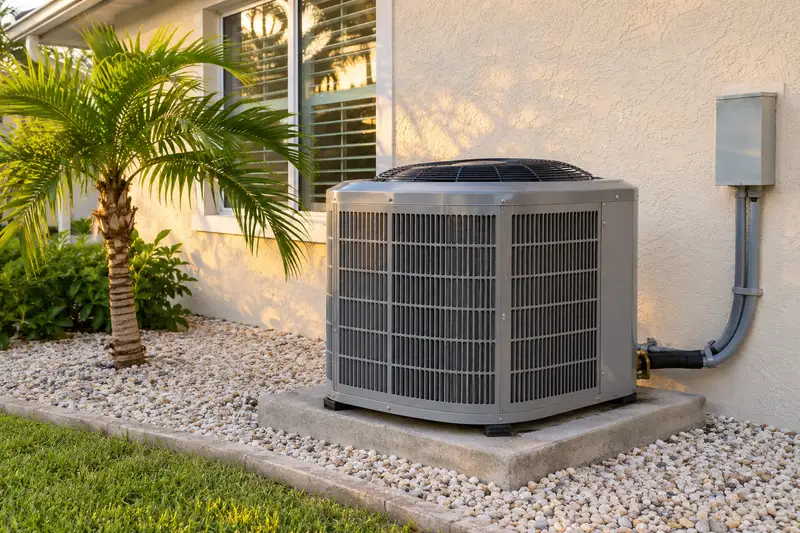
Should you repair or replace your AC after a breakdown?
Should you repair or replace your AC? The answer depends first on the part that failed. Some parts are small and routine to replace, while others, like the compressor, are the most important parts of the system.
Routine repairs
- Capacitor or contactor.
- Thermostat or wiring.
- Clogged drain or float switch.
- Fan motor.
- A single refrigerant leak at a joint or valve.
Major repairs
- Compressor failure.
- Indoor coil with many leaks.
- Outdoor coil badly corroded.
- Repeated refrigerant leaks.
- Several major parts failing together.
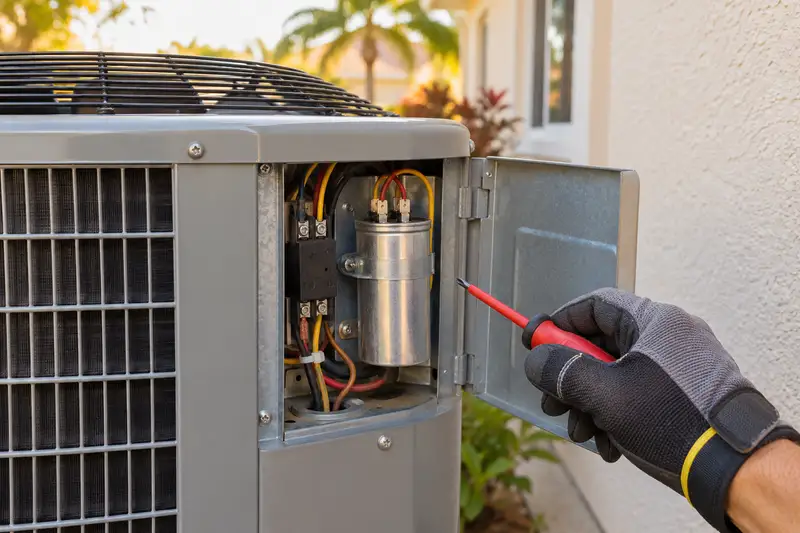
Signs that point toward repair
- The system has been reliable until now.
- The failed part is a common, simple one.
- The coils and compressor test healthy.
- The house cools evenly and feels dry when it works.
- Parts for your model are easy to get.
A capacitor or contactor failure on an otherwise sound system is a typical repair. Fixing it usually returns the system to normal.
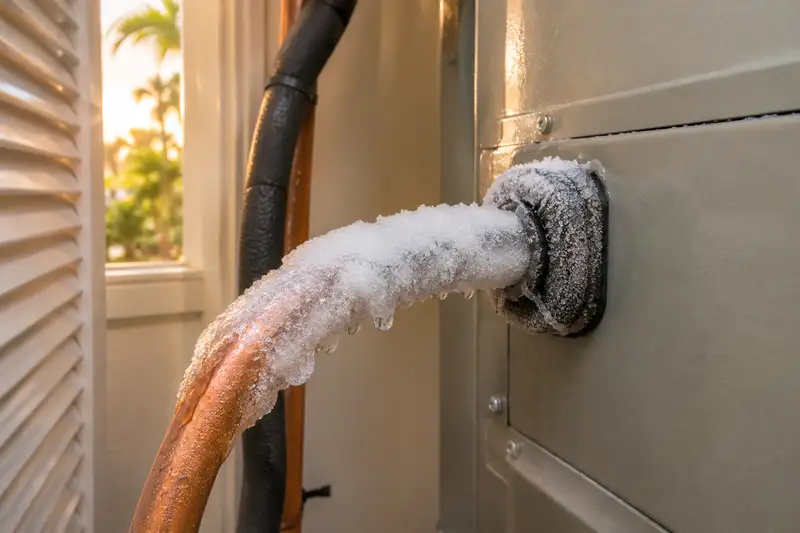
Signs that point toward replacement
- The compressor has failed on an older system.
- Refrigerant leaks keep returning after repairs.
- Repairs are stacking up year after year.
- The system uses an older refrigerant that is hard to get.
- The house never feels evenly cool or dry, even after repairs.
None of these alone settles it. Together, they suggest the system is near the end of its useful life, and the answer starts to lean toward replacing the AC.
Questions to ask before you repair or replace the AC
What exactly failed?
Ask whether the failed part is the cause or a symptom of something else.
How are the other major parts?
Ask about the condition of the compressor, the coils and the fan motors.
What refrigerant does the system use?
Older refrigerant types can make repairs harder.
Has this happened before?
Repeat failures point to a bigger problem.
How well does it cool and dry when it works?
A system that runs but never feels comfortable may not be worth repairing again.
A good technician answers these plainly and does not push either way. The choice stays with you.
Taking time to decide
If you feel rushed, it is fine to ask for time to think. A system that is cooling poorly but safely can usually wait a day while you decide. A system with an electrical fault or a water leak should stay off in the meantime.
Does the age of your AC decide it?
Should you repair or replace your AC just because it is old? Age alone is not a reason to replace it. In Cape Coral a system builds up running hours faster than one in a milder place, so it is worth paying attention to repeat problems sooner.
A system that has been maintained, with clean coils and a clear drain, often outlasts one of the same age that has been ignored.
Comfort problems a new system may solve
Uneven rooms
The cause can be the ducts or the size of the system, and a new system is a chance to fix both.
Sticky air
A correctly sized system dries the air better.
Noise
Newer outdoor units and blowers are often much quieter.
Short cycling
Oversized older systems can be replaced with one that fits.
Getting the most from a repair or a new system
- After a repair, book regular maintenance so other weak parts are caught early.
- With a new system, make sure it is sized for the house, not just matched to the old one.
- Either way, keep the drain clear and the filter fresh.
Repair or replace, by the part that failed
This table shows whether you should repair or replace your AC after each common failure.
This is a general guide, and your system may differ.
| Part that failed | Usual answer | Why |
|---|---|---|
| Capacitor | Repair | A small, common part that is quick to replace |
| Contactor | Repair | A simple switch that wears with use |
| Thermostat | Repair | Replaced or reset without touching the system |
| Condensate drain | Repair | Cleared and treated, sometimes with a new float switch |
| Outdoor fan motor | Usually repair | A motor swap on an otherwise healthy unit |
| Single leak at a joint | Usually repair | Found, sealed and recharged |
| Indoor coil with many leaks | Weigh both | Coil replacement is a large job on an older system |
| Compressor | Weigh both | The most important part, and often a sign the system is near the end of its life |
What a careful AC diagnosis includes
A good decision rests on good readings. Before anyone suggests replacing a system, these checks should be done and explained.
Electrical tests
The capacitor, contactor and motors are tested, so a simple fault is not mistaken for a major one.
Refrigerant readings
Gauge and line readings show whether the system is low on refrigerant or has a leak.
Compressor check
The technician confirms the compressor starts, runs and draws normal current.
Coil condition
The coils are checked for corrosion, dirt and signs of repeated leaks.
Airflow
The filter, blower and ducts are checked, because poor airflow can make a healthy system look weak.
If a compressor is said to have failed, ask how that was confirmed. A seized compressor and a failed start capacitor can look similar at first.
What to ask if you decide to replace your AC
- Ask for the system to be sized for your house rather than copied from the old one.
- Ask whether the ducts and returns suit the new system.
- Ask how the condensate drain and float switch will be set up.
- Ask about the thermostat, especially with a heat pump.
- Keep the paperwork and the model numbers somewhere safe.
A well matched new system should cool evenly, dry the air properly and run more quietly than the one it replaces. If you ever need to repair or replace the AC again, the paperwork from this install will help the next technician.
Repair or replace questions
How do I know if my AC is worth repairing?
If the failed part is routine and the compressor and coils are healthy, a repair usually makes sense.
Can an old AC keep running with repairs?
Many do, especially with good maintenance. Repeat major failures are the main warning sign.
Is it worth replacing a system that still runs?
Only if it is unreliable, uncomfortable or close to a major failure. Otherwise, maintain it.
Should I replace my AC before it fails?
Some people prefer to plan ahead with an older, unreliable system. Others run a healthy system for many more years with maintenance.
Will a repair hold up through a long summer?
A repair to a healthy system usually does. Repeat failures in the same season point to a deeper problem.
How many repairs are too many?
There is no fixed number. A pattern of major repairs in a short time, or the same failure returning, is a stronger signal than the count alone.
What if my system is old but working fine?
Keep up the maintenance. Being old is no reason on its own to replace a system that cools evenly, dries the air and runs reliably.
Is a noisy older system worth repairing?
If the noise comes from a loose panel or a worn fan motor, usually yes. Noise from a failing compressor is a reason to weigh both options.
Is a compressor failure always a reason to replace?
Not always, but on an older system it is often when replacement is worth weighing.
Does an older refrigerant mean I must replace?
Not immediately. It can make major repairs harder, which is a reason to plan ahead.
Can a capacitor failure look like a dead compressor?
Yes. Both can leave the outdoor unit humming without running. Testing tells them apart.
Can a dirty system look like it needs replacing?
Yes. Dirty coils, a clogged filter and a slow drain can make a healthy system cool poorly. Cleaning and a tune up sometimes restore it.
Does a repair make sense on a system with an older refrigerant?
For small faults, often yes. For a major leak or compressor failure, the limited supply of older refrigerant is a reason to weigh replacement.
Will a new AC fix humidity problems?
A correctly sized new system often dries the air better, especially if the old one was oversized.
Should I replace the indoor and outdoor units together?
Matching them is usually recommended so they work together properly.
What should I ask a technician?
What failed, the condition of the other major parts, the refrigerant type and whether this has happened before.
Does a new system need new ducts?
Not always. Ducts in good condition can often stay, though leaks should be sealed and sizes checked.
Should I get a second opinion before replacing?
If you feel unsure, it is reasonable. Ask what was tested, what failed and how the conclusion was reached.
Is a heat pump a good replacement for an AC and furnace?
Many homes here use heat pumps, because cooling is the main job and winters are short. A technician can explain whether one suits your house.
How do I keep a repaired system going longer?
Book yearly maintenance, change filters on schedule, keep the drain clear and keep the outdoor unit free of plants and debris.
Can I live with a system that cools but feels damp?
You can, but it may point to a dirty coil, low charge or oversizing. A check can often improve comfort without replacing anything.