What an AC capacitor and contactor do
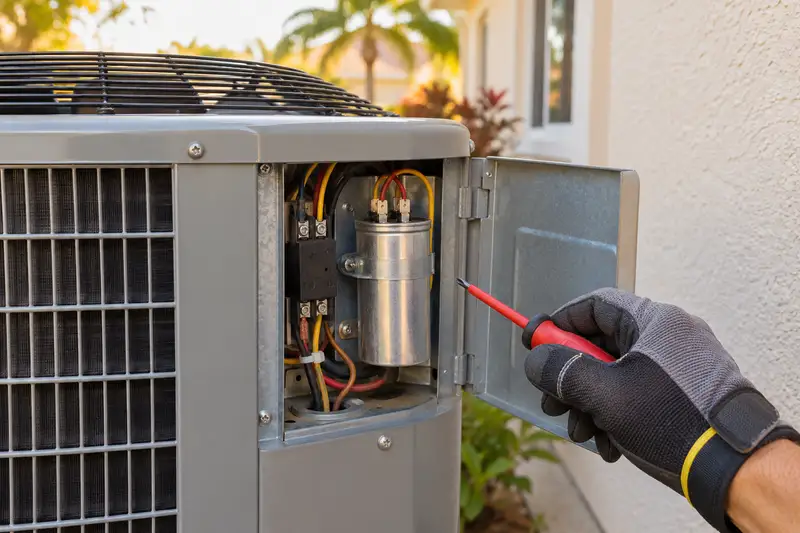
The AC capacitor in a Cape Coral home starts the system thousands of times a season. It gives the compressor and the outdoor fan the boost of power they need to start, then helps keep them running smoothly. The contactor is the switch that sends power to both when the thermostat asks for cooling.
The capacitor
A metal can, round or oval, that stores and releases a burst of energy to start the motors.
The contactor
A relay with contacts that close to power the outdoor unit and open when cooling stops.
Because air conditioning runs for much of the year here, both parts see heavy use. They are among the most common reasons a system stops cooling.
Stay safe before you look at the outdoor unit
A capacitor can hold a dangerous charge even with the power off. Leave the panel closed.
You can safely look at the outdoor unit from the outside, listen to it and check the breaker. Opening the service panel, touching the capacitor or pushing the contactor in with a stick are jobs for a technician with the right tools.
Signs of a bad AC capacitor or contactor
| What you notice | Usual cause | What to do now |
|---|---|---|
| Unit hums, fan does not turn | Weak or failed capacitor | Switch cooling off at the thermostat |
| Fan starts only after a long delay | Capacitor losing strength | Book a repair before it fails fully |
| Clicking, then nothing | Contactor or capacitor fault | Leave the system off and call |
| Outdoor unit runs with the thermostat off | Contactor stuck closed | Turn the breaker off and call |
| Unit silent, indoor fan running | Contactor not closing or no power | Check the breaker once, then call |
| Bulging or leaking can visible | Failed capacitor | Leave it alone and call |
A humming unit with a still fan is the one to act on quickly. The compressor tries to start, cannot and heats up, which can shorten its life.
Why heat wears out AC capacitors and contactors
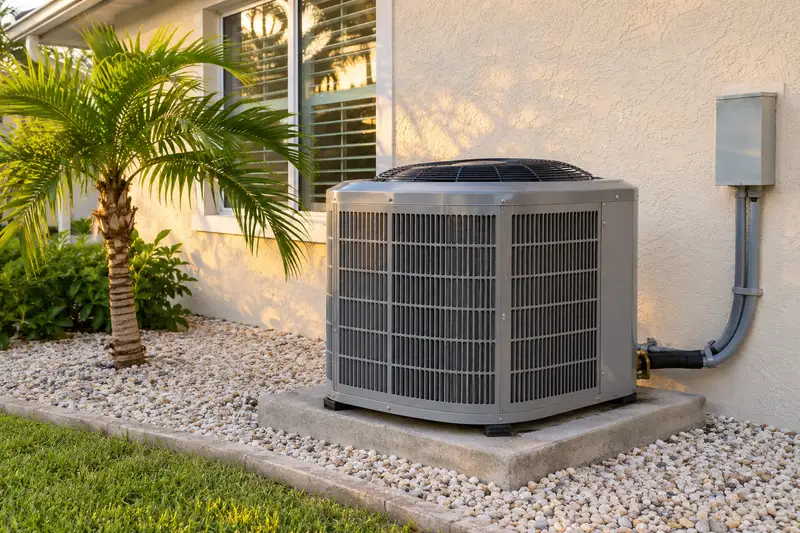
An AC capacitor in Cape Coral works harder than most, because the system starts and stops many times a day for much of the year. Capacitors are rated by temperature, and the outdoor unit sits in the heat for most of the year. Heat dries out the inside of the can and slowly lowers its strength.
Contactors wear in a different way. Each time the contacts close, a tiny spark pits their surface. After enough cycles they stick, chatter or stop closing at all. Insects and ants drawn to the warmth can also get between the contacts.
Heat waves, storms and repeated starts
Many breakdowns during a heat wave are caused by a worn start part. A capacitor that tests weak in spring may still start the system on a mild day but give out on the hottest afternoon.
Power that flickers during storms adds stress too. Short outages can make the system try to restart repeatedly, which is hard on both parts.
What AC capacitor and contactor repair covers
Replacing an AC capacitor in Cape Coral, FL is usually a short job once the readings confirm it has failed.
Make it safe
The technician turns off power at the disconnect and discharges the capacitor safely.
Test the parts
A meter shows whether the capacitor still holds its rated charge and whether the contactor closes cleanly.
Match the part
The new capacitor matches the rating on the old one, and the contactor matches the system voltage.
Check the motors
The compressor and fan are watched as they start, since a weak motor can wear out a new capacitor quickly.
Confirm cooling
The system runs and the air from the vents is checked before the visit ends.
You hear what the readings showed and why a part needs replacing before any work starts. If a motor looks close to failing too, you will be told that as well.
When the problem is bigger than a capacitor
Before replacing a Cape Coral AC capacitor, the technician also tests the contactor and the motors, since any of them can cause the same hum.
Usually a quick fix
- A weak or bulging capacitor.
- Pitted or stuck contactor points.
- Insects caught in the contactor.
- A loose wire on either part.
Worth a closer look
- A new capacitor fails again soon.
- The compressor will not start with a good capacitor.
- The fan motor turns slowly or runs hot.
- Breakers keep tripping after the repair.
Making start parts last longer
- Keep plants and fences at least two feet away from the outdoor unit so air can move around it.
- Clear ants and debris from around the base of the unit.
- Switch cooling off during storms when the power keeps flickering.
- Ask for a capacitor test during each maintenance visit.
A yearly test catches a weak capacitor before it fails on a hot day. See AC maintenance visits.
Capacitor and contactor questions
How do I know if my AC capacitor is bad?
A humming outdoor unit with a fan that will not spin, a slow start or a visibly bulging can are the usual signs. A meter test confirms it.
Why does my outdoor unit keep running when the AC is off?
A contactor stuck closed can keep power flowing. Turn the breaker off and have it replaced.
Is a humming AC dangerous?
It is not usually a fire risk, but it can damage the compressor. Switch cooling off and have it checked.
What does a bulging capacitor look like?
The top of the can swells or domes upward, and sometimes oil leaks from it. Do not touch it.
Can I replace a capacitor myself?
It is not recommended. Capacitors can hold a dangerous charge, and the replacement has to match the rating exactly.
What does a contactor do?
It is the switch that powers the outdoor unit when the thermostat calls for cooling and cuts power when cooling stops.
Is a contactor the same as a relay?
It is a heavy duty relay built to switch the high current an outdoor unit draws.
Do heat pumps use the same start parts?
Yes, and because they run in both seasons, their capacitors and contactors work even harder.
Will a bad capacitor damage my compressor?
It can. A compressor that keeps trying to start without help overheats, so it is worth switching the system off.
How long does a capacitor last?
It varies with heat and use. In a climate where the AC runs most of the year, a yearly test is the best way to know.
Why did my new capacitor fail so quickly?
A weak fan or compressor motor can draw too much current and wear a new capacitor out. The motors should be checked when a capacitor is replaced.
Can storms damage a capacitor?
Power surges and repeated restarts during flickering power can weaken it. Switching cooling off during storms helps.