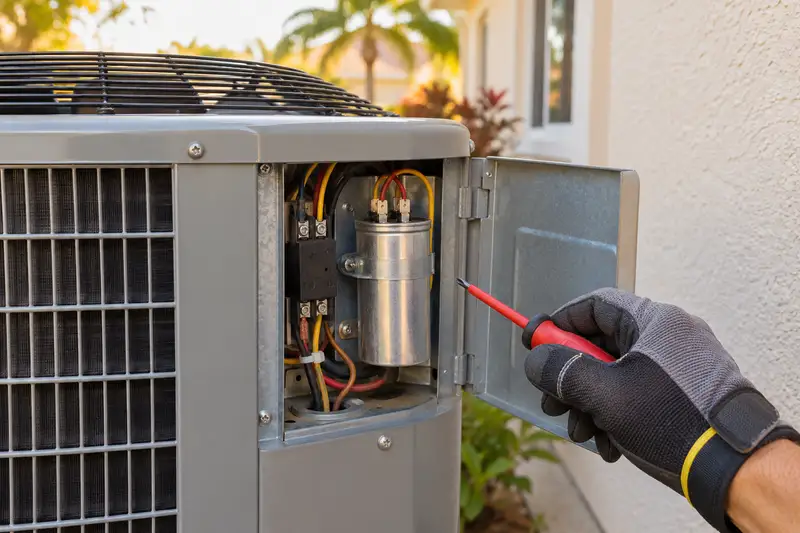
Normal sounds a healthy AC makes
Not every sound means trouble. Before AC noises are explained one by one, it helps to know which sounds a healthy system makes.
A soft hum
This is the compressor and fan running steadily.
A click at start and stop
This is the thermostat and contactor switching on and off.
A whoosh of air
This is the blower moving air through the ducts.
A brief whoosh in heat mode
This is a heat pump switching into its defrost cycle.
Common AC noises explained
This table covers the AC noises people ask about most. Where the sound comes from helps narrow down the cause.
| Sound | Where | Usual cause | How urgent |
|---|---|---|---|
| Loud humming, fan still | Outdoor unit | A dead capacitor or a fan motor that has seized | Switch off now |
| Buzzing | Outdoor unit or panel | Electrical fault, loose wiring or failing contactor | Soon, off if loud |
| Rapid clicking | Outdoor unit or thermostat | Contactor or control fault | Soon |
| Hissing | Indoor coil or lines | Refrigerant leak or a pressure change | Soon |
| Rattling | Outdoor or indoor unit | Loose panel, debris or a worn mount | Check soon |
| Squealing | Blower or fan | Worn motor bearing or belt | Soon |
| Grinding | Motor | Bearings failing | Switch off |
| Banging or clanking | Outdoor unit | Loose part or compressor trouble | Switch off |
| Gurgling | Air handler | Water in the drain or refrigerant flow | Usually minor |
Why electrical noises need attention right away
Buzzing, crackling or a burning smell from the outdoor unit or panel means switch it off and leave it off.
Electrical faults can damage motors and, rarely, become a fire risk. Do not open the panel or touch the capacitor, which can hold a charge even with the power off.
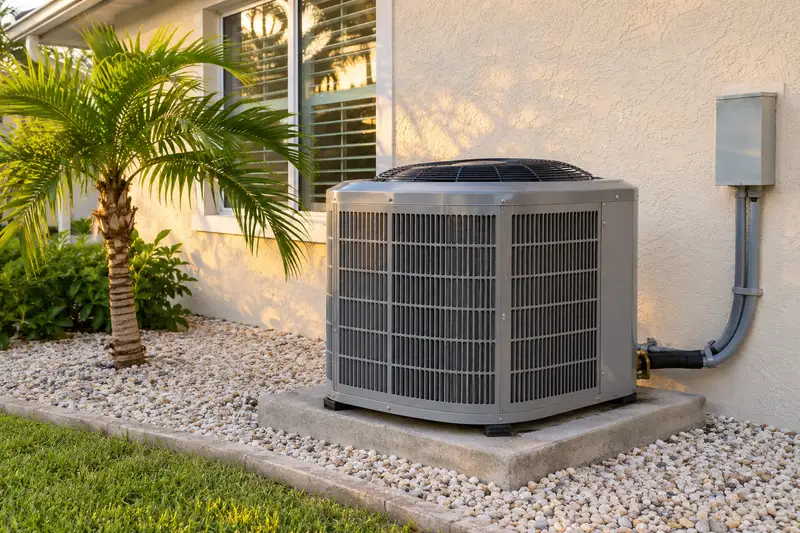
Rattles, squeals and loose parts
Many mechanical noises start small, such as a loose panel screw, a twig in the fan or a motor bearing that is starting to wear. Found early, these are simple fixes.
- Look around the outdoor unit for sticks, leaves or toys near the fan.
- Check that the panels are fastened and the unit sits level on its pad.
- Notice whether the sound changes when the fan speeds up.
- Listen inside near the air handler for squeals from the blower.
Never reach into the unit while it can run. Switch it off at the disconnect first.
What a hissing AC means
A short hiss when the system shuts off can be pressure equalizing, which is normal. A steady hiss while it runs, especially with weak cooling, often points to a refrigerant leak.
If hissing comes with ice on the lines or warmer air from the vents, see refrigerant leaks. The leak needs to be found before any refrigerant is added.
How to describe an AC noise to the technician
Describe it
Say whether it hums, buzzes, clicks, hisses, rattles, squeals, grinds or bangs.
Say where
Tell us whether it comes from the outdoor unit, the indoor unit, the ducts or the thermostat.
Say when
Tell us whether you hear it at start up, while it runs, when it shuts off or only in the afternoon.
Record it
A short phone video with sound is often the most useful thing you can share.
Before any work begins, the technician explains what is causing the sound and how it will be fixed.
How to keep your AC running quietly
- Book yearly maintenance, which includes tightening panels and checking motors.
- Keep the area around the outdoor unit clear of debris.
- Change filters regularly so the blower is not straining.
- Act on a new sound early rather than waiting for it to grow.
AC noises from inside the house
These AC noises start indoors, at the air handler, the ducts or the vents.
Whistling at a vent or return
This is often a filter that is too restrictive, a closed vent or a gap around the filter door.
Popping in the ducts
Metal ducts expanding and contracting as air temperature changes. Usually harmless.
A squeal from the air handler
This usually comes from worn blower motor bearings or, on older units, a belt.
Dripping inside the air handler
Water from the coil hitting the pan. Loud dripping can mean the drain is slow.
Rattling at the thermostat
This is rare, and usually a loose wall plate or a relay inside an older thermostat.
Gurgling in the drain line
Air and water moving together. Constant gurgling can point to a partial clog.
AC noises that change with the weather
Some noises only appear at certain times, and that timing helps explain the cause.
- A buzz that only shows up on the hottest afternoons often points to an electrical part struggling under load.
- Clicking that starts after a storm can mean the system is trying to restart after a power surge.
- A whoosh and a burst of steam from a heat pump on a cold morning is defrost, which is normal.
- Rattling that comes after windy weather is often debris or a loose panel.
Note when the sound happens and what the weather was. It helps the technician narrow the cause before the visit.
When your AC makes no sound at all
Silent outdoor unit, fan running inside
- Outdoor breaker or disconnect off.
- Contactor not closing.
- Failed capacitor.
- A control fault.
Nothing running at all
- Thermostat batteries or settings.
- Air handler breaker tripped.
- Float switch cutting power.
- Loose thermostat wiring.
The emergency checks walk through each of these in order.
AC noise questions
Why is my AC buzzing?
It is often an electrical issue, such as a failing contactor, loose wiring or a capacitor problem. Switch it off if the buzzing is loud.
Is a humming AC normal?
A soft hum while running is normal. A loud hum with a still fan usually means a failed capacitor.
Why does my AC hum when it is off?
A faint hum can come from the transformer or a contactor that is holding power. If it gets louder or warmer, have it checked.
Can a thermostat make a buzzing sound?
A faint buzz can come from a relay or a loose wire. A loud or constant buzz is worth having checked.
Why does my AC click when it turns on?
A single click is the contactor or thermostat switching. Rapid clicking is a fault worth checking.
Why is my outdoor unit rattling?
A loose panel, debris in the fan or a worn mount are the usual causes.
Can I fix a rattling AC myself?
With the power off, you can clear debris and check visible screws. Leave motors and electrical parts to a technician.
Why does my outdoor unit click but not start?
The contactor may be trying to close, or the capacitor may be too weak to start the motors. Switch cooling off and have it checked.
Is a vibrating outdoor unit a problem?
A gentle vibration is normal. Strong shaking can mean a loose mount, an unbalanced fan blade or a compressor problem.
Does a banging sound always mean the compressor?
Not always. A loose part striking the fan or cabinet can bang too. Switch off and have it checked either way.
Can debris inside the outdoor unit cause noise?
Yes. Sticks and leaves that fall through the top can hit the fan blades. Switch off at the disconnect before removing anything you can see.
What does a hissing AC mean?
A steady hiss while running often points to a refrigerant leak.
Why does my AC whistle?
A restrictive filter, closed vents or a gap around the filter door can make air whistle.
Are popping sounds in the ducts a problem?
Usually not. Metal ducts expand and contract as the air temperature changes.
Why does my heat pump make a whooshing sound in winter?
That is the defrost cycle clearing frost from the outdoor coil.
Can a noisy AC be a sign of low refrigerant?
A steady hiss or bubbling while it runs can be. Weak cooling usually comes with it.
Can noise come from the ducts rather than the AC?
Yes. Popping, whistling and rattling grilles are common duct and vent sounds, and most are minor.
Why do I hear water running inside the walls?
Usually condensate moving through the drain line while the system runs. Constant gurgling with water at the air handler means the drain may be slow.
Is a squealing AC dangerous?
It usually means a worn motor bearing or belt. It is not an emergency, but it gets worse.
Should I turn off my AC if it is making a loud noise?
For grinding, banging, loud buzzing or a hum with a still fan, yes.
Why is my AC louder than it used to be?
Dirt on the fan, worn motor bearings, loose panels or a struggling compressor can all raise the noise level. A maintenance visit usually finds the cause.
Should I record the sound before calling?
Yes. A short phone video with sound helps the technician narrow down the cause before arriving.
Why does my AC squeal when it starts?
It is usually a worn motor bearing, or a belt on older air handlers. The squeal usually fades as the motor warms, then returns louder over time.