Why low refrigerant always means a leak
Refrigerant moves in a sealed loop
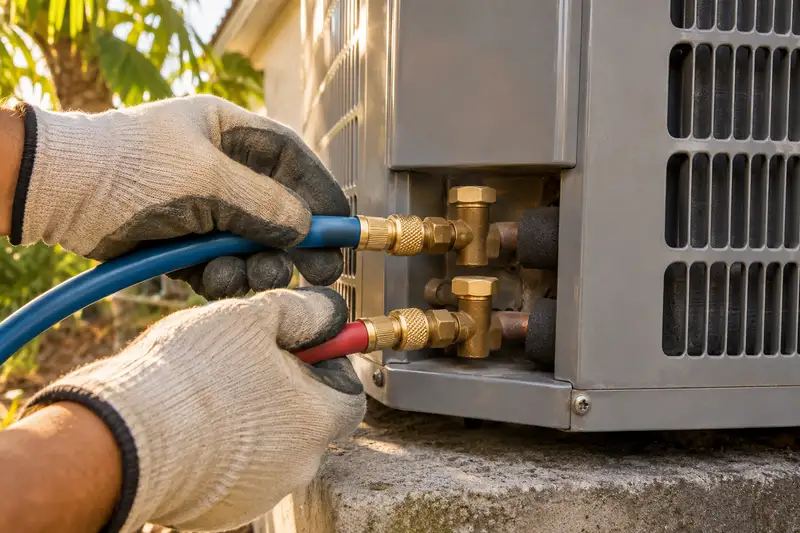
Refrigerant moves in a closed loop between the indoor coil and the outdoor unit, picking up heat inside and releasing it outside. It is not burned or consumed. If a refrigerant leak in a Cape Coral home goes unnoticed, the system slowly loses its ability to cool.
Adding refrigerant without finding the leak is like topping up a tire with a nail in it. It may help for a while, but the problem comes back, and the system runs short of charge in the meantime.
How to tell if your AC has a refrigerant leak
Weak cooling that worsens
The house cools a little less each week, especially in the afternoon.
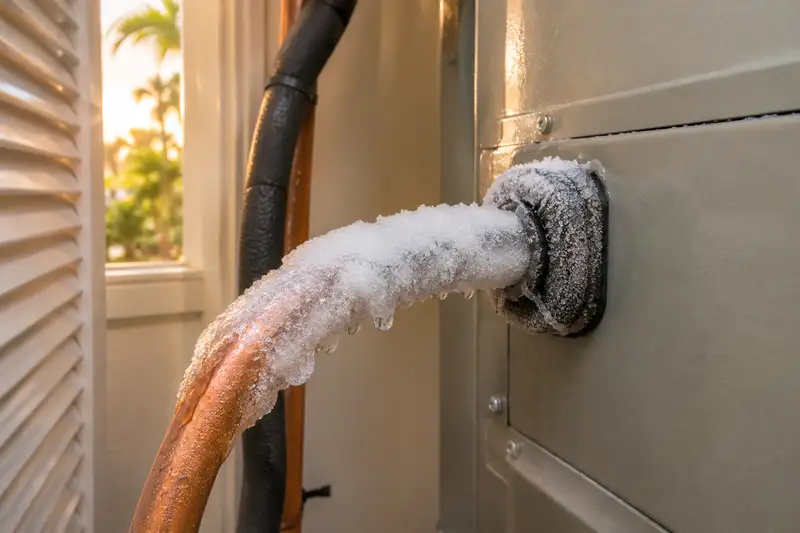
Ice on the lines
Low charge makes the indoor coil too cold, so frost forms on the copper line.
A hissing or bubbling sound
Heard near the indoor coil or the outdoor unit when the system runs.
Oily spots
Refrigerant carries oil, so a leak often leaves a greasy patch on a joint.
Longer run times
The system runs and runs without reaching the thermostat setting.
Humid, clammy air
Low charge reduces how much moisture the coil removes.
Where refrigerant leaks usually start
A refrigerant leak in a Cape Coral home most often starts at one of these points, where metal meets metal or where vibration and moisture wear on the system over the years.
| Spot | Why it leaks |
|---|---|
| Indoor coil | Tiny pinholes from corrosion in the thin coil tubing |
| Brazed joints | Joints where copper lines meet can crack with vibration |
| Service valves | The ports where gauges connect can seep at the core or cap |
| Outdoor coil | Debris, moisture and corrosion wear the fins and tubes |
| Line set | Copper lines rubbing against a wall or a sharp edge |
| Flare fittings | Common on some systems, they can loosen over time |
Why coils are a common source of leaks
In a humid climate, coils stay damp for much of the year, which gives corrosion more time to work. A leak in the indoor coil is one of the most common finds on an older system.
Some leaks are so small they only show under pressure or with a sensitive detector, which is why finding them properly takes time.
How a technician finds a refrigerant leak
Fixing a refrigerant leak in Cape Coral properly means finding it first, then sealing it, then charging the system to the right level.
Read the charge
Gauges and temperature readings confirm that the system is low.
Search the system
An electronic detector, bubble solution or dye is used on joints, valves and coils.
Pressure test if needed
For hard to find leaks, the system can be tested with nitrogen under pressure.
Explain the options
The technician shows you where the leak is and explains the repair, and nothing starts until you agree.
What refrigerant leak repair covers
How a refrigerant leak in Cape Coral, FL is repaired depends on where the leak is.
Often repairable
- A leaking service valve core.
- A loose flare fitting.
- A single cracked joint.
- A rubbed line set section.
Repair or replacement worth discussing
- Several pinhole leaks in an indoor coil.
- Repeat leaks after earlier repairs.
- An older system on an older refrigerant.
- Corrosion across the outdoor coil.
After a repair, the system is evacuated and charged to the right level, and the cooling is checked before the visit ends.
How to prevent refrigerant leaks
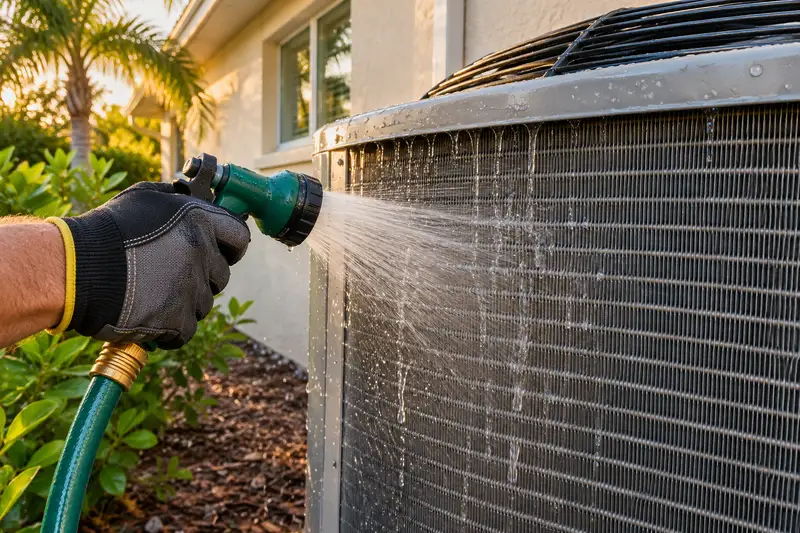
- Rinse the outdoor coil gently a few times a year to clear dust and pollen.
- Keep the copper line set supported and away from sharp edges.
- Do not let anyone add refrigerant without explaining where the leak is.
- Book yearly maintenance so small leaks show up early.
Caps on the service valves should always be in place. A missing cap is an easy way for a slow leak to start.
Older systems and older refrigerants
A refrigerant leak in Cape Coral, FL is harder to handle on an older system. Some older systems still run on a refrigerant that new equipment no longer uses. Supplies for those systems are limited, which makes a major leak on an older unit a good moment to weigh repair against replacement.
Newer systems use refrigerants designed for today and cannot simply be topped up with the old type. The label on the outdoor unit shows which one your system uses, and a technician can explain what that means for a repair.
Refrigerant leak questions
How do I know if my AC has a refrigerant leak?
Weak cooling that gets worse, ice on the lines, a hissing sound or oily spots on joints are the common signs.
Is a refrigerant leak dangerous?
In the small amounts found in home systems it is mostly a comfort and equipment problem. Ventilate the area if you notice a strong chemical smell.
Why does low refrigerant freeze the coil?
Low charge drops the pressure in the indoor coil, which makes it colder than freezing, so moisture in the air turns to ice.
Will my AC stop working completely if it has a leak?
Not straight away. It cools less and less, may freeze up, and the compressor works harder until it eventually fails.
Can a refrigerant leak make my house humid?
Yes. Low charge reduces how much moisture the coil removes, so the air can feel damp even when it is cool.
Why do leaks often show up in summer?
The system runs harder and longer in the heat, so a small loss of charge shows up sooner as weak cooling.
Does an AC need refrigerant topped up every year?
No. A healthy system holds its charge. If it needs more, it has a leak.
Can I add refrigerant myself?
No. Handling refrigerant requires certification, and adding it without fixing the leak does not solve the problem.
Can a leak be fixed without replacing the coil?
Often, if it is at a joint, valve or fitting. Leaks spread across a corroded coil usually mean replacing the coil.
Should the leak be fixed even if cooling still seems fine?
Yes. A system that is losing charge will keep losing it, and running low strains the compressor.
Can a leak come back after a repair?
A properly repaired leak should hold. A new leak elsewhere on an older, corroded coil is possible, which is why repeat leaks point toward a coil replacement.
How long does a leak search usually take?
Some are found in minutes. Small leaks can take longer and may need a pressure test.
Does a leak search damage my walls or ceilings?
No. Detectors and bubble solution are used on the accessible parts of the system, such as the coils, valves and joints.
What happens after the leak is repaired?
The system is evacuated to remove air and moisture, charged to the correct level and checked while it cools the house.