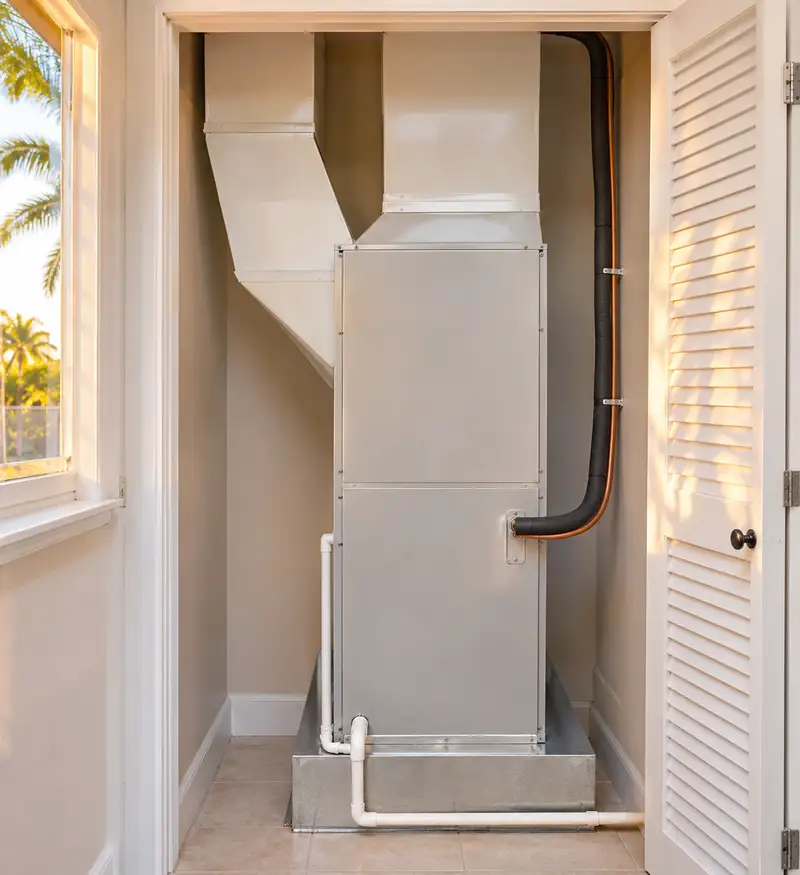
Three checks before anything else
When the AC is not cooling in Cape Coral, the cause is often one of these simple problems. Each check takes under a minute.
Thermostat
Make sure it is set to Cool, the fan is on Auto and the target is a few degrees below the room temperature. A blank screen often means dead batteries.
Filter
Pull it out and hold it up to a window. If no daylight shows through, the filter is blocking airflow and the coil may be freezing.
Breakers and switch
Check the AC breakers in the panel and the disconnect beside the outdoor unit. Reset a tripped breaker once only.
If the breaker trips again, leave it off. A breaker that trips twice usually means an electrical fault that needs a technician.
Common causes of an AC blowing warm air
Once the simple checks are done, most cases of an AC not cooling in Cape Coral trace back to one of the causes in this table.
| What you notice | Likely cause | What it means |
|---|---|---|
| Outdoor unit silent | Tripped breaker, failed contactor or capacitor | Power is not reaching the compressor |
| Outdoor fan still, unit humming | Weak or failed capacitor | The motors cannot start on their own |
| Frost on the large copper pipe | Not enough airflow or refrigerant | The coil is too cold and freezing over |
| Air cool, never cold | Dirty coil, low charge or a leaky duct | Cooling is happening but not enough |
| Cold for a while, then warm | Overheating compressor or short cycling | The system protects itself by shutting down |
| Some rooms fine, others warm | Duct leak, closed dampers or blocked vents | Air is not reaching every room |
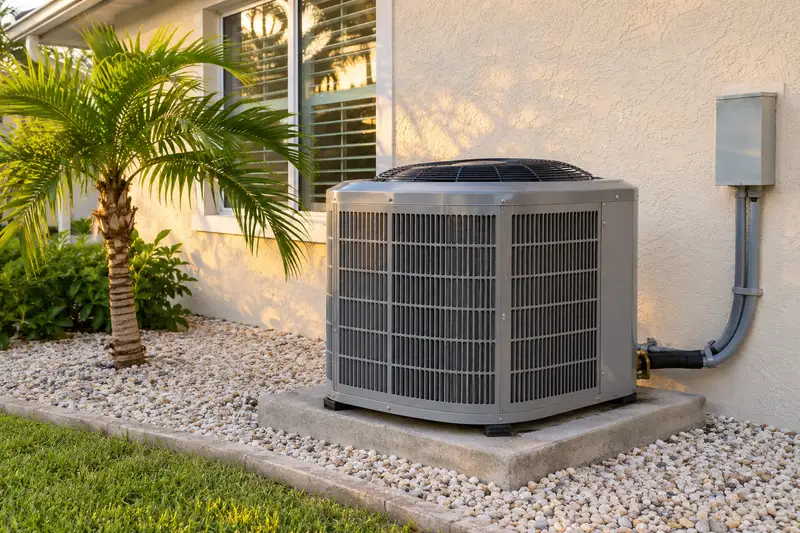
Why it happens more in long heat waves
Long, hot summers wear parts out faster
An AC not cooling in Cape Coral is most common in the first long heat wave of the year, when weak parts finally give out.
A system that kept up in spring can fall behind once it has to run for hours without a break.
Heat is hard on the parts that start the system. Capacitors weaken, contactor points pit and outdoor coils clog with pollen and dust, so the unit sheds less heat just when it needs to shed the most.
Why the AC falls behind in the afternoon
Humidity adds to the load. The AC removes moisture as well as heat, and on sticky days a lot of its effort goes into drying the air. A system that is slightly undercharged or has a dirty coil shows the weakness first as a house that feels cool but clammy.
If your AC keeps the house cool overnight but falls behind every afternoon, that pattern is a useful clue. Mention it when you call.
When an AC that is not cooling needs help today
Worth calling today
- The indoor temperature keeps climbing on a hot day.
- Someone at home is elderly, very young or unwell.
- The breaker trips again after one reset.
- You smell burning or see scorch marks.
- Water is spreading from the air handler.
Usually fine to schedule
- The house cools, just more slowly than before.
- One room runs warmer than the rest.
- The system is short cycling but still cooling.
- You noticed a new sound but cooling is normal.
If heat is a health risk for anyone in the house, treat the call as urgent and keep them in the coolest room with fans and fluids while you wait.
What happens during the repair visit
A visit for an AC not cooling in Cape Coral follows the path cooling takes through the house, from the thermostat on the wall to the condenser outside.
Confirm the call for cooling
The technician checks that the thermostat is sending the signal and that the indoor blower responds.
Test power and starting parts
Voltage at the outdoor unit, the contactor and the capacitor are measured, since these fail most often.
Read the refrigerant side
Gauge pressures and line temperatures reveal whether the charge is correct and the compressor is pumping.
Check airflow
Filter, blower, indoor coil and return air are inspected for blockages and ice.
Explain and repair
You hear what failed, what the fix involves and whether anything else is close to failing. The work waits for your go ahead.
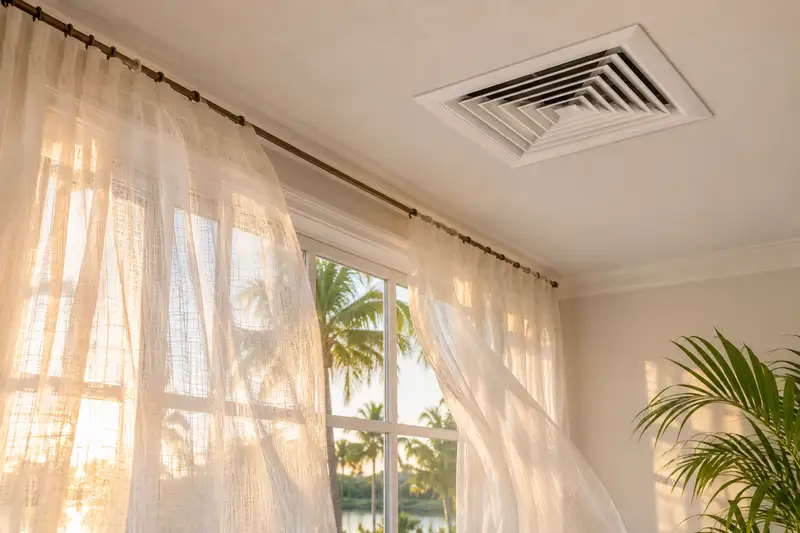
Rooms that stay warm and the ducts behind them
Sometimes the AC is cooling fine and the air simply is not arriving. Ducts run through hot attics, and a loose joint or a crushed section can dump cold air where nobody feels it.
- Hold a hand to each supply vent. A weak or warm stream points to that branch.
- Look for dust streaks around vents and ceiling grilles, a sign of leaks.
- Make sure return grilles are not blocked by furniture or rugs.
- Check that interior doors are not starving rooms of return air.
If one side of the house is always warmer, mention which rooms. It helps the technician decide whether the problem is the system or the air path.
How the technician measures cooling
Diagnosing an AC not cooling in Cape Coral starts with measurements. These are the readings a technician takes when the vents blow warm air.
Temperature split
The difference between the air going into the return and the air leaving the vents. A small split means weak cooling.
Refrigerant pressures
Gauges on the outdoor unit show whether the charge is right and the compressor is pumping.
Superheat and subcooling
Two calculations that confirm the charge and spot restrictions in the system.
Capacitor rating
A meter shows whether the capacitor still holds the charge printed on its label.
Amp draw
How hard the compressor and motors are working compared with what they should draw.
Static pressure
How freely air moves through the filter, coil and ducts.
You do not need to remember any of these, but it is worth asking which readings were off, because the answer explains the repair.
What AC not cooling repair covers
Repair for an AC not cooling in Cape Coral usually covers one or more of these.
Capacitor replacement
One of the most common fixes. A weak capacitor stops the compressor or fan from starting.
Contactor replacement
The switch that sends power to the outdoor unit. Pitted contacts cause silent or erratic starts.
Coil cleaning
Dirty outdoor or indoor coils cannot move heat. Cleaning restores capacity.
Leak repair and recharge
If refrigerant is low, the leak is found and repaired before the system is charged.
Drain clearing
A float switch shuts the AC off when the drain backs up. Clearing it restarts cooling.
Fan motor repair
A seized outdoor fan lets the compressor overheat and shut down.
Keep cool air flowing next summer
- Change or clean the filter every month during the hottest stretch.
- Keep the outdoor unit clear of plants, mulch and grass clippings.
- Rinse the outdoor coil gently with a hose a few times a year, power off.
- Keep supply vents open, even in rooms you rarely use.
- Book a maintenance visit before the first long heat wave.
Our page on AC maintenance visits explains what a proper tune up covers.
Why the filter is the first thing to check
The filter matters more than most people expect. A clogged filter cuts airflow across the indoor coil, which can freeze it, overheat the blower and make the whole system run longer for less cooling. In a home where the AC runs much of the year, a monthly look is the simplest habit that prevents warm air calls.
If you have pets or ongoing work in the house, filters clog faster. Keep a few spares on hand so a change is never put off.
Questions about an AC not cooling
Short answers to the questions people ask when their AC is not cooling.
What makes an AC run all day yet blow warm air?
Common causes are a clogged filter, a weak capacitor, low refrigerant, a frozen coil or an outdoor unit that is not running. The three checks at the top of this page rule out the simple ones.
Can low refrigerant cause warm air?
Yes. Refrigerant does not get used up, so low charge means a leak. The leak should be found and repaired before the system is recharged.
Why does my AC cool at night but not in the afternoon?
In the hottest part of the day the system works hardest. A dirty coil, a weak capacitor or slightly low charge shows up first as a house that gets warmer every afternoon.
Why is the air from my vents humid as well as warm?
When cooling slows down, the system also removes less moisture, so the air feels warm and sticky at the same time. Fixing the cooling usually fixes the humidity too.
Can a clogged drain stop my AC from cooling?
Yes. On many systems a float switch cuts cooling when the drain backs up, to stop an overflow. Clearing the drain restarts the system.
Why is my outdoor unit running but the house is still warm?
The compressor may not be pumping, the refrigerant may be low or the indoor airflow may be blocked. Gauges and a temperature check show which.
Why does my AC blow warm air right after it starts?
A few seconds of warm air while the system starts is normal. If it stays warm after several minutes, the compressor or outdoor fan is probably not running.
Could a power outage stop my AC from cooling?
Yes. After an outage, breakers can trip or the system can lock out for a few minutes. Our guide on resetting an air conditioner covers the safe way to restart it.
Should I turn my AC off if it is not cooling?
If ice is forming or the outdoor unit is humming without the fan turning, yes. Running it can damage the compressor.
Is it normal for one room to stay warmer?
A small difference is common. A large one usually points to a duct problem, a closed vent or a blocked return.
Can I clean the outdoor unit myself?
With the power off at the disconnect, you can clear debris and rinse the fins gently with a hose. Leave refrigerant and electrical work to a technician.
Will closing vents in empty rooms help the rest of the house?
Usually not. Closing too many vents can starve the coil of air, raise duct pressure and even freeze the coil. Keep most vents open.
Can tall plants around the outdoor unit stop it cooling?
Yes. The unit needs room to pull air through its coil. Plants pressed against it trap hot air and cut capacity.
Do ceiling fans help when the AC is struggling?
They make a room feel cooler by moving air across your skin, which helps while you wait. They do not lower the temperature, so switch them off in empty rooms.
How long should my AC take to cool the house?
It depends on the size of the home and the heat outside, but a system in good shape brings the temperature down steadily. If it runs for hours without progress, something is wrong.
Will a new thermostat fix warm air?
Only if the thermostat is the cause. Most warm air problems come from the outdoor unit, the refrigerant or airflow.
Is it worth repairing an older AC that is not cooling?
It depends on what failed. A capacitor or contactor on an older unit is usually worth replacing. A failed compressor on an older system is when replacement is worth weighing.